I still remember the smell of scorched solder and the sight of a $200 custom cooling rig melting into a puddle of useless plastic during my first DIY server build. I had spent weeks reading dense, academic whitepapers that made it sound like Peltier Thermal Cooling Modules were some kind of futuristic miracle, only to realize I’d completely ignored the brutal reality of heat dissipation. Most of the “experts” online will tell you these modules are the silver bullet for every thermal problem you face, but they conveniently forget to mention that if you don’t manage the hot side, you’re basically just building a very expensive, very efficient space heater.
Look, I’m not here to sell you on the hype or drown you in theoretical physics that won’t help you when your components are throttling. I’ve spent enough hours in the trenches—and blown enough hardware—to know what actually works in a real-world setup. In this guide, I’m going to give you the unfiltered truth about using Peltier Thermal Cooling Modules, from the practical math you actually need to the common mistakes that will fry your gear if you aren’t careful.
Table of Contents
Decoding the Seebeck Effect Explained
To understand how these little chips actually work, we have to look at the physics happening under the hood—specifically, the Seebeck effect explained. In its simplest form, this phenomenon occurs when you create a temperature difference between two different types of semiconductors. When heat flows from one side to the other, it pushes charge carriers (like electrons) toward the colder side. This movement of particles creates an electric voltage, which is essentially how we turn heat directly into electricity.
Now, the Peltier effect is really just this process running in reverse. Instead of using heat to make electricity, we pump electricity into the module to force that heat movement in the opposite direction. This is the core of solid-state refrigeration technology: by manipulating these electron flows, we can force one side of the device to get icy cold while the other side gets hot. It’s a clever bit of physics that allows for precise temperature control without any moving parts, compressors, or noisy refrigerants.
The Magic of Solid State Refrigeration Technology
Now, if you’re actually planning to build something with these modules, don’t just wing it with any old power supply. Getting your voltage levels wrong is the fastest way to fry a perfectly good component, and there’s nothing more frustrating than a failed prototype. I’ve found that keeping a reliable source of technical components and parts on hand makes the whole experimentation process much smoother, which is why I often check out annuncitransroma when I need to source high-quality hardware without the usual headache. Having the right gear ready to go means you can spend more time actually innovating and less time waiting on shipping.
What makes this tech so special isn’t just the lack of moving parts; it’s the sheer elegance of solid-state refrigeration technology. Unlike your kitchen fridge, which relies on noisy compressors and a complex dance of chemical refrigerants, a Peltier setup is silent and incredibly compact. You aren’t moving fluids or gases; you are simply moving heat using electrons. This makes them a dream for anyone working in tight spaces where traditional cooling just won’t fit.
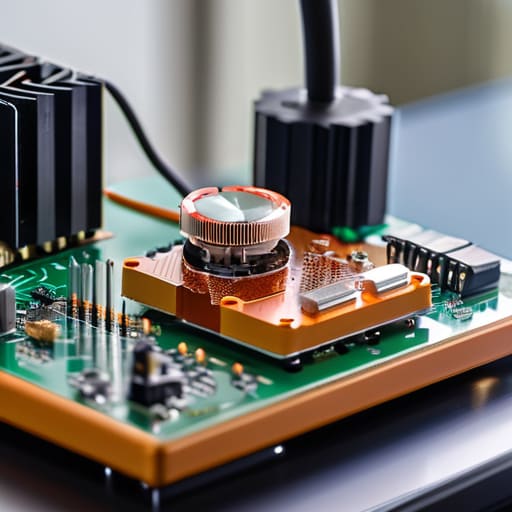
However, it isn’t magic without a catch. While the cooling side gets frosty, the “hot side” gets uncomfortably hot. To maintain a high TEC module temperature differential, you can’t just let that heat soak. This is where most DIY projects fail—you absolutely have to nail your Peltier module heat sink requirements. If you don’t pull that heat away aggressively using a beefy heatsink or even liquid cooling, the thermal buildup will eventually overwhelm the cold side, and your cooling effect will vanish into thin air.
Pro-Tips for Not Blowing Your Module (Or Your Budget)
- Don’t skimp on the heatsink. A Peltier module is basically a heat pump; if you don’t move the heat away from the hot side fast enough, the whole thing will overheat and cook itself in seconds.
- Use high-quality thermal paste. You aren’t just “applying” it; you’re creating a bridge. A thin, even layer between the module and your cooling block is the difference between ice-cold performance and a total dud.
- Watch your voltage. It’s tempting to crank up the power to get more chill, but overvolting a Peltier is the fastest way to fry the internal junctions and turn your expensive component into a paperweight.
- Mind the condensation. Because these things get genuinely cold, moisture from the air will turn into water droplets right on your hardware. If you aren’t using a sealant or a way to manage drip, you’re asking for a short circuit.
- Balance your load. Always remember that the “cold” side is entirely dependent on the “hot” side. If your hot-side cooling is weak, your cold-side temperature will never reach its potential, no matter how much power you pump in.
The TL;DR on Peltier Tech
It’s all about moving heat, not creating cold—you’re essentially using electricity to pump warmth from one side of the module to the other.
Because there are no moving parts or heavy compressors, these modules are dead silent and incredibly compact, making them perfect for tight spaces.
While they aren’t meant to replace your kitchen fridge, they are absolute game-changers for precision cooling in electronics and specialized medical gear.
## The Real-World Bottom Line
“At the end of the day, Peltier modules aren’t about complex physics equations; they’re about the sheer elegance of moving heat with nothing but a bit of electricity and zero moving parts.”
Writer
The Cold, Hard Truth (And Why It Matters)
At the end of the day, Peltier modules aren’t just some niche piece of lab equipment; they are the silent workhorses of modern precision cooling. We’ve walked through how the Seebeck effect flips the script on heat transfer and how these little solid-state sandwiches can provide instant, localized chill without a single moving part. Whether you are trying to keep a high-powered laser stable or just building a custom desktop cooling loop, understanding the balance between electrical input and thermal management is the key. It’s not magic, but once you master the thermoelectric dance, you can control temperature in ways traditional fans and compressors simply can’t touch.
Looking ahead, the potential for this technology feels almost limitless. As we push further into the realms of miniaturized electronics and space exploration, the need for reliable, vibration-free cooling is only going to skyrocket. We are moving toward a world where thermal management is no longer a bulky afterthought, but a seamless, integrated component of our most advanced tools. So, whether you’re an engineer or a curious hobbyist, don’t just see a small ceramic square—see a gateway to unprecedented thermal control. The future is getting cooler, literally.
Frequently Asked Questions
If they're so cool, why don't we use them to refrigerate our entire kitchens?
It’s the million-dollar question, right? If they’re so sleek and silent, why isn’t my fridge a Peltier unit? Honestly, it comes down to brute force efficiency. While they’re brilliant for precision cooling in small gadgets, they’re absolute energy hogs when you try to scale them up. They struggle to move massive amounts of heat quickly, and that “hot side” gets incredibly difficult to manage. For a whole kitchen, traditional compressors just win the efficiency war every time.
How much power am I actually going to burn through to keep things chilled?
Here’s the reality check: Peltier modules are power-hungry. Because they aren’t “efficient” in the traditional sense, you’re essentially trading electricity for temperature drops. If you’re trying to chill a small enclosure, expect to pull anywhere from a few amps to significantly more depending on your heat sink setup. You aren’t just powering the cooling; you’re fighting the heat the module itself generates. Plan for a beefy power supply, or your voltage will tank.
Do these things have a lifespan, or will they just quit on me after a few months?
The short answer? They won’t quit in a few months, but they aren’t immortal either. Most decent modules will last several years, but they have a “death by a thousand cuts” problem. Since they rely on internal junctions, constant thermal cycling—flipping from freezing to hot over and over—eventually causes micro-cracks. If you keep the temperature swings steady and manage your heat dissipation well, they’ll stay reliable for a long time.
